Showing posts with label conference. Show all posts

Sunday, August 9, 2015

SITE workshops on Psych and Econ, and on Experimental Econ, Aug 10-14

Starting tomorrow, a week of behavioral and experimental econ at Stanford...

August 10-12, 2015
The location for this session will be the Arrillaga Alumni Center, 326 Galvez St., Stanford campus
Organized by:
  • Doug Bernheim, Stanford University
  • John Beshears, Harvard University
  • Vincent Crawford, University of Oxford
  • David Laibson, Harvard University
  • Ulrike Malmendier, University of California, Berkeley
This workshop will focus on recent research in behavioral economics. While the standard model of economic decision-making has proven useful in a wide variety of settings, its limitations are also well-documented. The field of behavioral economics seeks to enrich the standard model, thereby improving its descriptive and predictive accuracy, by incorporating insights from psychology and other disciplines, and to examine the implication of those enriched models for a wide variety of important economic issues, such as the effects of policies affecting spending, saving, labor supply, and investment. While considerable progress has been made in this subfield, our theoretical and empirical understanding of economic behavior remains incomplete.


August 13-14, 2015
The location for this session will be the Arrillaga Alumni Center, 326 Galvez St., Stanford campus
Organized by:
  • Katherine Baldiga Coffman, Ohio State University
  • Christine Exley, Harvard Business School
  • Muriel Niederle, Stanford University
  • Alvin Roth, Stanford University
  • Lise Vesterlund, University of Pittsburgh
This session is dedicated to advances in experimental economics combining laboratory and field-experimental methodologies with theoretical and psychological insights on decision-making, strategic interaction, and policy. We invite papers in lab experiments, field experiments, and their combination that test theory, demonstrate the importance of psychological phenomena, and explore social and policy issues.
Presentation theme groupings:
  • Time Inconsistency - Thursday 9-10:30am
  • Social Preferences - Thursday 11am-12:30pm
  • Generosity & Giving - Thursday 2-3:30pm
  • Shorter Papers and Future JM Candidates - Thursday 4-6pm
  • Experimental Techniques - Friday 9-10:30am
  • Incentive Schemes - Friday 11am-12:30pm
  • Theory Experiments - Friday 2-3:30pm
  • Consumption (Positive & Negative) - 4-5:30pm

Sunday, August 2, 2015

Plan ahead: the 2016 Meeting of the Society for Social Choice and Welfare in Lund


The 13th Meeting of the Society for Social Choice and Welfare

JUNE 28 - JULY 1 2016, AT LUND UNIVERSITY


The Society for Social Choice and Welfare will organize its 13th biennial meeting in Lund, Sweden, from 28th June to 1st July, 2016. We welcome you to attend the meeting, and submit and present your research.

Key-note speakers

  • Arrow Lecture: Hans Peters (Maastricht University)
  • Condorcet Lecture: Gabrielle Demange (Paris School of Economics)
  • Presidential Adress: Claude d'Aspremont (Universite Catholique de Louvain)
  • Social Choice and Welfare Prize: Fuhito Kojima (Stanford University) and Parag Pathak (MIT)
The venue for the conference is AF-borgen which is located in the beautiful parkLundagård in the very heart of Lund. In this historical area, you can also find theLund University main buildingLund CathedralKungshuset, and Kulturen.

Monday, July 13, 2015

The Economist as Engineer at Exeter, July 14 and 15

Tomorrow is the conference for which I traveled to England, here's the announcement:

Economic Design: The Economist as an Engineer 14-15 July 2015

Al Roth, winner of the Nobel Prize 2012 in Economics, will receive an honourable doctorate from the University of Exeter. The Department of Economics with funding from the South West Doctoral Training Centre (SWDTC) and the University of Exeter Business School is proud to host a workshop in honour of Al Roth and his contribution to market design.
How to bring different parties together in the best possible way is a key economic problem. Examples of situations where this problem arises include matching children with different schools, interns with internships, and kidneys or other organs with patients who require transplants. The two-day workshop will focus on applying economic theory to solutions for "real-world" problems.

Speakers

NameInstitutionPaper
Alvin RothStanford University"Who Gets What and Why: The New Economics of Matchmaking and Market Design" and "Kidney exchange"
Vincent CrawfordUniversity of OxfordEfficient Mechanisms for Level-k Bilateral Trading
Bradley RuffleWilfrid Laurier UniversityWaiting to Cooperate? Cooperation in one-stage and two-stage games
Joana PaisUniversity of LisbonAffirmative action through minority reserves: An experimental study
Surajeet ChakravartyUniversity of ExeterCommunicating with an ignorant agent
Burak CanMaastricht UniversityComparing Orders, Rankings, Queues, Tournaments and Lists
Dorothea KueblerWZB BerlinCollege Admissions with Entrance Exams: Centralized versus Decentralized
Luke LindsayUniversity of ExeterHow to organise a conference: A market design approach
Dirk EngelmannHumboldt UniversityDoes a Buyer Benefit from Bad Reputation? Theory and Experiments on Auctions with Default
Elizabeth BaldwinLSEUnderstanding Preferences: "Demand Types", and the Existence of Equilibrium with Indivisibilities
As part of the workshop Al Roth will present a public talk, details below: 
Who Gets What and Why: The New Economics of Matchmaking and Market DesignTuesday 14th July at 2pm – 3.30pm
Streatham Court A
Please register your attendance online – REGISTER HERE

Workshop programme


Friday, July 10, 2015

NBER workshop on Market Design: call for papers (October 23-24, in Cambridge)

Mike Ostrovsky and Parag Pathak have announced the following call for papers:

From:  Michael Ostrovsky and Parag Pathak
To:  NBER Market Design Working Group

The National Bureau of Economic Research workshop on Market Design is
a forum to discuss new academic research related to the design of
market institutions, broadly defined. The next meeting will be held in
Cambridge, Massachusetts, on October 23-24, 2015.

We welcome new and interesting research, and are happy to see papers
from a variety of fields. Participants in the past meeting covered a
range of topics and methodological approaches.  Last year's program
can be viewed at:  http://conference.nber.org/confer/2014/MDs14/program.html

The conference does not publish proceedings or issue NBER working
papers - most of the presented papers are presumed to be published
later in journals.

There is no requirement to be an NBER-affiliated researcher to
participate.  Younger researchers are especially encouraged to submit
papers.

If you are interested in presenting a paper this year, please
upload a PDF version by August 1, 2015 to this link:
http://papers.nber.org/confsubmit/backend/cfp?id=MDf15

Preference will be given to papers for which at least a preliminary
draft is ready by the time of submission. Only authors of accepted
papers will be contacted.

For presenters and discussants in North America, the NBER will cover
the travel and hotel costs. For speakers from outside North America,
while the NBER will not be able to cover the airfare, it can provide
support for hotel accommodation.

There are a limited number of spaces available for graduate students
to attend the conference, though we cannot cover their costs. Please
email ppathak@mit.edu a short nominating paragraph.

Please forward this announcement to any potentially interested
scholars.  We look forward to hearing from you.

Tuesday, June 30, 2015

Scott Kominers on market design (and a conference in August)


Prof. Scott Duke Kominers: ‘There are many new areas of market design worth exploring’


Kominers 1
Prof. Scott Duke Kominers is a Junior Fellow at the Harvard Society of Fellows, a Research Scientist at the Harvard Program for Evolutionary Dynamics, and an Associate of the Harvard Center for Research on Computation and Society. He also will be a General Co-Chair at AMMA 2015, The Third Conference on Auctions, Market Mechanisms and Their Applications. We talked with him about the upcoming conference and about the most interesting potential areas in market design and the challenges this field will face in the near future.

AMMA 2015 will be held August 8-9, 2015 in Chicago. What will the main focus of the conference be?

AMMA focuses on the theory and practice of market design, at the intersection of economics, computer science, operations research, and applied math.

What are, in your opinion, interesting potential areas researchers in the field of market design should take into account?


Kominers
Prof. Scott Duke Kominers, General Co-Chair at AMMA 2015

Market design has already proven useful in addressing real-life problems in settings like school choice, entry-level labor markets, kidney exchange, and auction design. Financial market design has flourished recently, as has the design of intellectual property markets. Personally, I am especially excited about “generalized matching,” which blends together ideas from matching and auction theory to show how markets with complex contract structure can be cleared using relatively simple mechanisms. I think there’s a lot of potential for generalized matching mechanisms to be useful in new real-world applications. In addition, there are many new areas of market design worth exploring: market designers are starting to think about the structure of healthcare marketplaces and adoption services. And of course, online platforms are everywhere. Furthermore, a popular press book on market design has just been published: http://www.hmhbooks.com/whogetswhat/index.html.

What challenges do you expect market design will face in the near future?

I think one of the greatest challenges going forward is about translation: we need to find good ways of teaching what we know about marketplace design to policymakers, entrepreneurs, and other practitioners. In some cases, there is work to be done in understanding how to simplify our mechanisms in ways that would make them more accessible to their users. Meanwhile, on the research side, market design has traditionally mixed powerful theory with empirical analysis, experiments, and computational methods. As we build more and more technical facility with our existing tools, and as we add new approaches to our toolkits, it is increasingly challenging – but also increasingly important – to make sure that we let real-world structure guide our methodological choices in applied work.

Saturday, June 20, 2015

Thursday, June 18, 2015

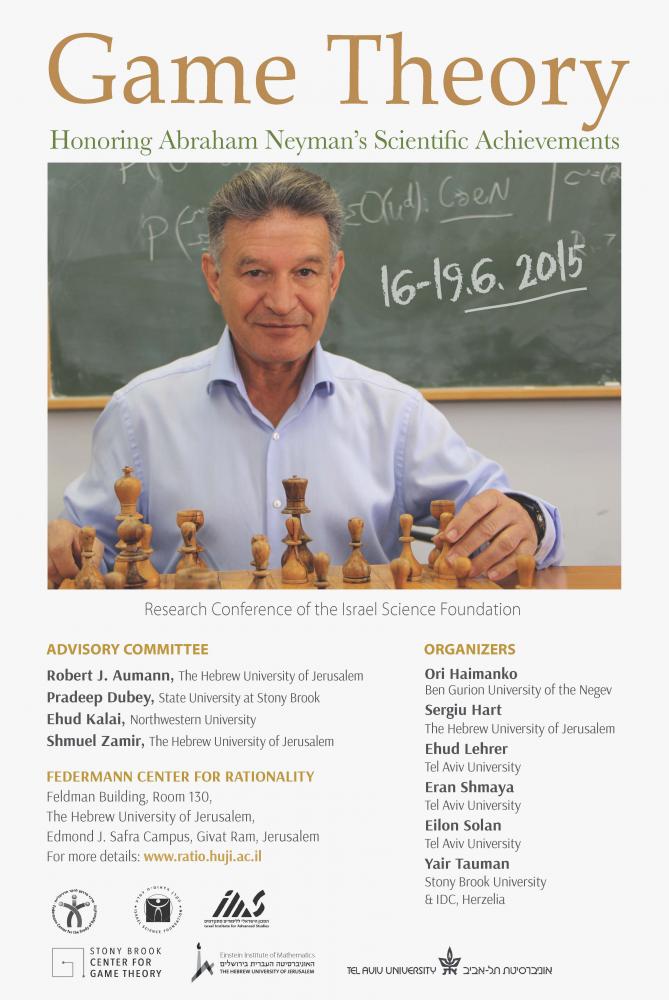
Abraham Neyman's talk on Stochastic Games at the Conference in His Honor

I'm acutely aware that I'm missing two important conferences in Jerusalem during these days, in honor of Abraham Neyman, and Sergiu Hart.  The Neyman Conference is underway:
Here is Neyman's talk from the conference:


Yom Holedet Sameach, Abraham!  I'm sorry to have to miss the party.

Thursday, May 21, 2015

Royal Economic Society-York Symposium and Mini-Courses on Game Theory, 21-23 May 2015


The 2015 RES-York Symposium and Mini-Courses on Game Theory, the 6th of the series of York Annual Symposium on Game Theory, will be held on 21-23 May 2015 at the Department of Economics and Related Studies, University of York, UK. 

The four keynote speakers of the Symposium (21-22 May 2015) are: 


Bhaskar Dutta (Warwick)

Stephen Morris (Princeton)

Michael Ostrovsky (Stanford)

Eyal Winter (HUJerusalem & Leicester)


The event is organised by the Micro Theory Research Cluster at the Department of Economics and Related Studies (DERS)University of York, and is jointly supported by the Royal Economic Society and the departmental Research Impact Support (RIS) Fund at DERS, University of York.

 Mini-Courses
Right after the Symposium, on Saturday 23 May 2015, we will run two mini-courses delivered by Professor Bhaskar Dutta (Warwick) and Professor Michael Ostrovsky (Stanford), respectively.

Professor Bhaskar Dutta will deliver a mini-course on "Games on Networks". 

Professor Michael Ostrovsky will deliver a mini-course on the topic "Matching in Trading Networks". The background reading can be downloaded below at this webpage.

The schedule on Saturday 23 May 2015 is as follows.

9:00-10:30 Course by Prof. Bhaskar Dutta

10:45-12:15 Course by Prof. Michael Ostrovsky

12:15-13:15 Lunch

13:15-14:45 Course by Prof. Bhaskar Dutta

15:00-16:30 Course by Prof. Michael Ostrovsky


Saturday, May 16, 2015

9th workshop Matching in Practice June 8 - June 9 in Barcelona

9th workshop Matching in Practice, June 8 - June 9

The program for the 9th workshop of Matching in Practice is up:

Scientific Program

Day 1: June 8, 2015 
11:00 – 11:30     Welcome Coffee 
11:30 – 12:00     Registration
12:00 – 13:30    Keynote presentation – Christopher Avery (Harvard Kennedy School of Government)
The Common Application and the DA Algorithm in School Assignment (with Cara Nickolaus and Parag Pathak)
13:30 – 14:30     Lunch
14:30 – 16:30     Strategic Choice and Affirmative Action
Dynamic Reserves in Matching Markets with Contracts: Theory and Applications, by Orhan Aygün and Bertan Turhan
College Admission with Multidimensional Privileges: The Brazilian Affirmative Action Case, by Orhan Aygün and Inacio Bo
Self-selection in School Choice, by Li Chen and Juan Sebastián Pereyra
16:30 – 17:00     Coffee break
17:00 – 18:30     Empirical Estimation of Preferences in School Choice
Demand Analysis using Strategic Reports: An application to a school choice  mechanism, by Nikhil Agarwal and Paolo Somaini
Structural Estimation of a Model of School Choices: the Boston Mechanism vs. Its Alternatives, by Caterina Calsamiglia, Chou Fu and Maia Güell
20:00                  Dinner
Day 2: June 9, 2015 
9:30 – 11:00       Educational Choice, Incentives and Welfare
College Diversity and Investment Incentives, by Thomas Gall, Patrick Legros and Andrew F. Newman
 Socio-economic status and enrollment in higher education: Do costs matter? by Koen Declercq and Frank Verboven
 11:00 – 11:30     Coffee break 
11:30 – 12:15       Re-matching
The Design of Teacher Assignment: Theory and Evidence, by Julien Combe, Olivier Tercieux and Camille Terrier
12:15 – 13:00      Panel discussion on matching practices (TBD)
13:30                     Lunch

Scientific Committee: Dorothea Kübler, Antonio Miralles and Joana Pais

Registrations If you plan to attend the meeting (and are not a speaker), please contact Antonio Miralles at amirallesasensio@gmail.com

Venue: Universitat Pompeu Fabra, Edifici Balmes, Carrer Balmes 132, Barcelona

Sunday, April 26, 2015

Multi-unit allocation workshop at Penn, Apr 26, 2015

WORKSHOP ON MULTIUNIT ALLOCATION , April 26


TimeSpeaker/Presentation
9:30 - 10:30 amJacob Leshno (Columbia)
A Supply and Demand Framework for Two-Sided Matching Markets 
10:45 - 11:45 amBumin Yenmez (CMU Econ)
Matching with Externalities 
11:45 - 12:45 pmBreak
12:45 - 1:45 pmMichael Richter (Yeshiva)
Continuum Mechanism Design with Budget Constraints
2:00 - 3:00 pmGabriel Y. Weintraub (Columbia)
Repeated Auctions with Budgets in Ad Exchanges: Approximations and Designs 
3:15 - 4:15 pmHaoxiang Zhu (MIT)
Welfare and Optimal Trading Frequency in Dynamic Double Auctions 
4:30 - 5:30 pmTadashi Hashimoto (Yeshiva)
Equilibrium Selection and Inefficiency in Internet Advertising Auctions

Organizer: Mariann Ollar
Sponsored by the UPenn Market Design Working Group
*********************

A quick internet search for the marriage-market illustration yields this: