Showing posts with label interview. Show all posts

Monday, July 27, 2015

Roger Doooley interviews me about Who Gets What and Why


Ep #68: Disrupting Markets with Nobel Winner Al Roth

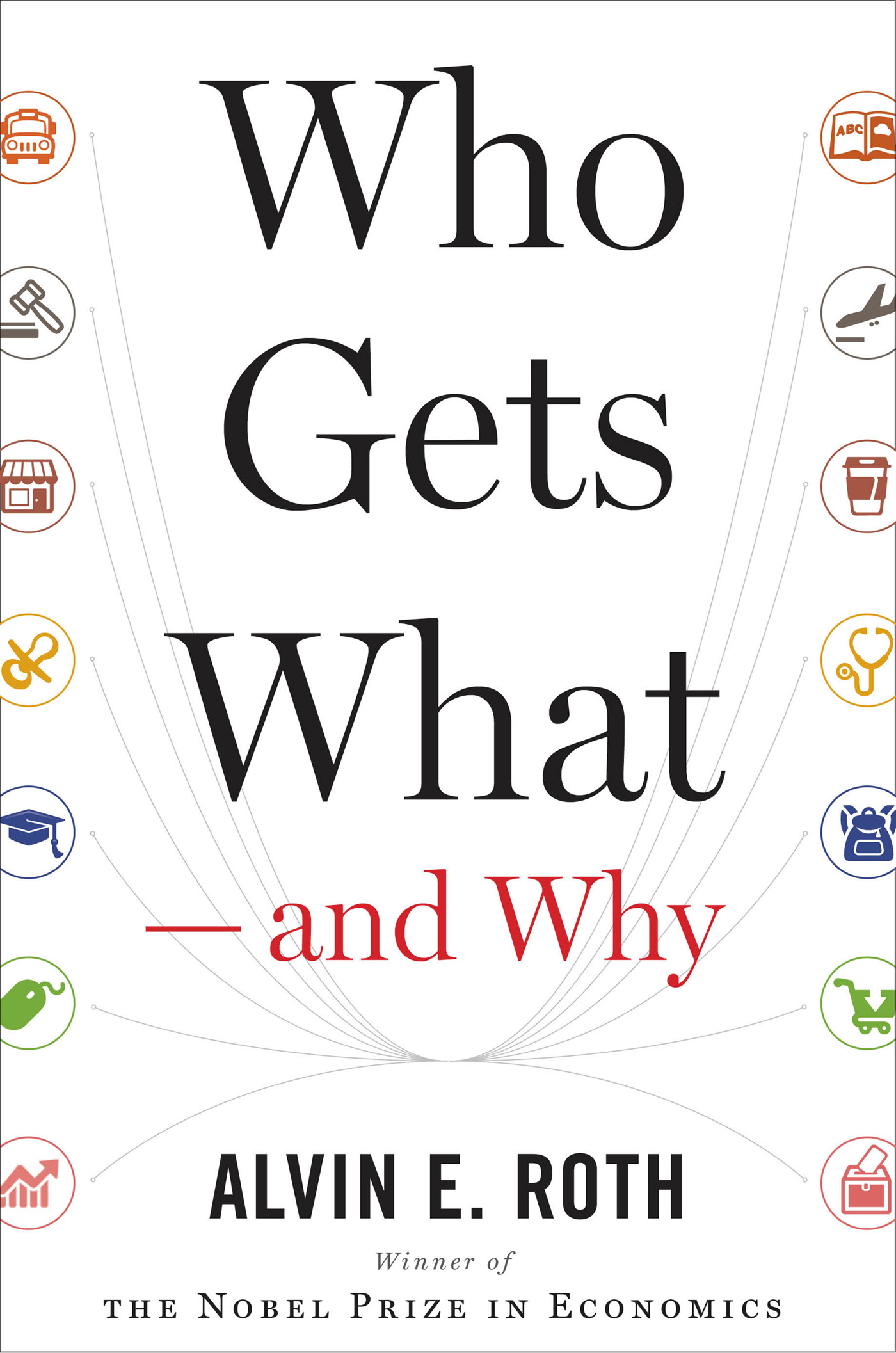
My guest today on The Brainfluence Podcast is quite a unique scholar. Al Roth is the Craig and Susan McCaw Professor of Economics at Stanford University, as well as the Gund Professor of Economics and Business Administration Emeritus at Harvard University. He is the author ofWho Gets What And Why: The New Economics of Matchmaking and Market Design. He also happens to have been awarded the Nobel Prize for Economics in 2012.
While winning a Nobel Prize makes Al unique, what sets him apart is his application of his knowledge of economics in solving seemingly intractable real-world problems. His insights have resulted in market creation in areas like city-wide school admissions, hospital internship negotiations, and kidney transplants that save thousands of lives each year.
Today, we’re going to hear how an economics professor turned into a lifesaver and how you can apply some of Al’s insights to your business ventures. The principles that Al has brought to the medical field, and that have been used in some of the great entrepreneurial successes in recent history, are readily accessible to you. These same principles can be used to understand and identify novel business opportunities, reshape the way you view your business and help you experience incredible success.
If you enjoy the show, please drop by iTunes and leave a review while you are still feeling the love! Reviews help others discover this podcast, and I greatly appreciate them!

Listen in:

Saturday, July 11, 2015

Cheating in China on (American) college admissions

Inside Higher Ed has the story: In China, No Choice But to Cheat?
July 9, 2015 By
"EUGENE, Ore. -- Is the admission process broken for Chinese applicants to American colleges?
Variations of that question came up again and again during sessions on Wednesday at the Overseas Association for College Admission Counseling [OACAC] conference. Persistent concerns about standardized test fraud, doctored transcripts and fake admission letters -- and the role of agents in helping to "pollute" the application process (as one session description put it) -- are causing some to worry that Chinese students might think cheating is their only choice.
"We need to make it [the application process] safe for honest applicants," said Terry Crawford, the chief executive officer and co-founder of InitialView, a video interviewing company based in Beijing.
"There's a perception in China that the system is rigged, that if you pay enough money you're going to get the results that you want," Crawford said. He cited a recent China Newsweek article laying out the process and prices for cheating on the Test of English as a Foreign Language (TOEFL) as just one example of the type of story that feeds into this perception (the reporter received test answers during the exam via a small, wireless-enabled watch)."
**************

Interestingly, Initial View, the company that Terry Crawford and Gloria Chyou founded in China, was initially founded to address the problem of fraud in English language tests, by offering applicants the opportunity to make a video of an unscripted interview that they conduct, to be sent to colleges, who can then confirm the fluency of the speaker, and later verify that the student who enrolls is the one who took the interview.

Saturday, July 4, 2015

Podcast interview about Who Gets What and Why

Here's Episode 196 – Alvin Roth from Smartpeoplepodcast.com. The interview starts at around one and a half minutes from the beginning of the audio file.

Wednesday, July 1, 2015

Video conversation about Who Gets What on Yahoo! Finance


Below is a link to a Yahoo! Finance video interview (about 5 minutes), made when I was in NYC for the launch of  Who Gets What and Why the first week in June. Unlike most of the interviews I've done, this one has video footage added, so instead of always looking at me and the interviewer, there are scenes of things that we're talking about--the stock exchange, an Amazon warehouse, etc..

Nobel Prize-winning economist on the elusive factors that make markets work

Thursday, June 25, 2015

Peter Passell interviews me at the Milken Institute on Who Gets What — and Why: The New Economics of Matchmaking and Market Design

I had a busy day in Los Angeles Tuesday, which combined some academic meetings with some media events related to my new book.

Here's a video of an interview/conversation about the book, with Peter Passell,


****************

Earlier in the day, I had a conversation on the air with Larry Mantel on his radio show Airtalk, at
NPR affilliate in Los Angeles: KPCC (you can hearthe talk at the link)


Incidentally, here's a radio talk I taped when I was in Boston but just aired, on NPR's affilliate for the Cape and the Islands: Listen here to the conversation with WCAI's Mindy Todd about Who Gets What and Why.

Tuesday, June 23, 2015

Talking about markets on Think Radio, and Radio New Zealand

Here's an NPR radio show, in which I was interviewed about Who Gets What and Why

Most economists study commodity markets, in which buyers and sellers find common ground in the price of goods. This hour, we’ll talk to Nobel Prize-winning economist Alvin E. Roth about matching markets ­­ like employment and college admission  in which money is only one factor in making a connection. Roth’s new book is Who Gets What — and Why: The New Economics of Matchmaking and Market Design (Houghton Mifflin Harcourt).

The webpage also has this picture, which must be what I look like on radio:)
***************

And here you can hear what I sound like on Radio New Zealand:

Nobel Prize winner, Alvin Roth: "Who Gets What and Why"

Updated at 11:18 am on 22 June 2015

Originally aired on Nine To Noon, Monday 22 June 2015

Al Roth portrait Steve CastilloProfessor Alvin Roth won the Nobel Prize for economics partly for his work helping match willing donors with those who need kidney transplants.
He has spent his career looking at markets of all kinds and how ‘buyer’ and ‘seller’ come together. In his new book, Who Gets What and Why, he argues we are surrounded by matching markets. From applying for a job, to asking someone out on a date, matching plays a crucial but invisible role in our lives.
Professor Roth says matching is why apps like uber and airbnb are so successful, but while he is an advocate of market forces, as he tells Kathryn Ryan, there must also be rules.
  • Play
  • Download:Ogg  |  MP3
  • Audio duration:( 25:44 )
Photo: Steve Castillo

Sunday, June 21, 2015

Who Gets What and Why at the Milken Institute in Santa Monica, June 23

This should be fun--I'll be interviewed Tuesday by Peter Passell, whose columns I used to read in the NY Times, about my new book  .( A bit more on Peter Passell at the end of this post...)

Alvin Roth, McCaw professor of economics at Stanford University and Nobel laureate
Moderated by Peter Passell, editor of the Milken Institute Review
June 23, 2015
6:30pm - 8:00pm
Santa Monica


Who Gets What and Why
Markets are about more than money. Price isn’t the crucial factor in matching aspirants with career opportunities, students with schools or bodily organs with transplant patients, yet these examples involve markets nonetheless. Alvin Roth, a Nobel laureate in economics and the author of “Who Gets What — and Why: The New Economics of Matchmaking and Market Design,” has created markets meant to lift the barriers that hinder the goals of individuals and society at large. Roth is an authority on the application of exchange dynamics to real-world problems, inventively adapting the tools of game theory and market design.
At this Milken Institute Forum, Roth will demonstrate that markets are ubiquitous, if even we don’t commonly recognize them, and how skillfully we navigate them can determine the most important events in our lives. Even the freest markets have rules, and Roth will delve into how unseen conditions drive outcomes. Those conditions can be modified to better serve the participants, he explains. From marriage to parking spaces, if the “buyers” and “sellers” can be matched more effectively, everyone wins.
“Alvin Roth guides us through the jungle of modern life, pointing to the many markets that are hidden in plain view all around us,” says behavioral economist and “Predictably Irrational” author Dan Ariely. “He teaches us how markets work—and fail—and how we can build better ones.”
ABOUT THE AUTHOR
Roth Alvin
Alvin Roth is the McCaw professor of economics at Stanford University and co-recipient of the 2012 Nobel Prize in economics. Roth is one of the world’s leading experts in the fields of market design, game theory, and matching markets. He has designed several of those markets, including the system that increases the number of kidney transplants by better matching donors to patients, the exchange that places medical students in residencies and the New York City and Boston school choice systems.

ABOUT THE MODERATOR
Peter Passell
Peter Passell is editor of the Milken Institute Review, the Institute's economic quarterly. A senior fellow, Passell was previously an economics columnist for the New York Times, a member of the Times' editorial board and an assistant professor at Columbia University's Graduate Department of Economics. Passell has written for publications including the Washington Post, the New Republic, the Nation, American Economic Review and the Journal of Political Economy. Passell received his Ph.D. in economics from Yale University.


"Who Gets What — and Why: The New Economics of Matchmaking and Market Design" will be for sale after the Forum, and Roth will be available to sign copies.
This event is open to the public, although registration is required. Reserved seating is available for Milken Institute Associates. If you are not currently a member of the Associates and would like to join or receive more information, click here. Parking is not available at the Institute. Free parking for 90 minutes is available in Public Parking Lot No. 1 on Fourth Street, adjacent to our building.
This Forum is part of our effort to present multiple perspectives on current business and public policy issues. Videotaping, recording or photographing this event is prohibited without the prior approval of the Milken Institute.
***********

A funny thing about this interview is that I recall reading Peter Passell's 'Economic Scene' column in the NY Times when he seemed to be one of the few economic journalists who was an actual economist. Here's the last of those columns he wrote for the Times, which still reads very well today.

Economic Scene; Rich nation, poor nation. Is anyone even looking for a cure?
By Peter Passell
Published: August 13, 1998

Friday, June 19, 2015

Two interviews by the Minneapolis Fed with two Stanford economists: me -- and Raj Chetty

The Minneapolis Fed publishes a magazine called The Region that features long interviews with economists, accompanied by nice photos. Their current issue, just out, has an interview with me.

You can read the whole thing here:

Interview with Alvin Roth

Stanford economist on matching theory, kidney markets and the importance of coffee

Douglas Clement | Editor, The Region  Published June 15, 2015   |  June 2015 issue

Here's the final exchange, about Pittsburgh and coffee:

"Region: One last question, if I might. Many of your major breakthroughs occurred when you were at Pittsburgh. What was it about the research environment there that was so conducive to Nobel-winning work?
Roth: Well, Pittsburgh was a lot of fun. The living was easy. I walked to work. I’d walk with my kids to school and drop them off and walk on into work. My colleagues and I spent a lot of time drinking coffee and talking about economics.
The mathematician Alfréd Rényi is said to have said that a mathematician is a machine for turning coffee into theorems. Maybe economists turn decaf into models.
There were lots of people to talk to at Pittsburgh. It was a fruitful time. And it was a very good department. I think a lot of what makes a department a good place to work is that when you’re onto something you’re excited about and you walk out the door of your office and tell one of your colleagues about it, he’s excited to hear about it, too. He says “That’s great. Let’s go have a cup of coffee, and you can tell me about it.” So there’s the positive reinforcement you get just from having people think, “Isn’t that great you’re excited about something. You’re thinking about something interesting.” It makes places fun to work.
Here at Stanford, I try to organize regular coffees—I did this at Harvard and I do it here—regular coffees with students interested in different things. We have a Tuesday morning coffee for experimental economics and a Thursday morning coffee for market design. I think that a lot of intellectual interaction arises out of social interaction. You have to be talking to people before you’re talking about work.
Region: Wonderful. It’s been a pleasure talking with you. Thank you."
***************************

The December 2014 issue had an interview with an even better-looking economist

You can read it here:

Interview with Raj Chetty

Harvard economist explores work on income mobility, education, taxation and labor supply

Douglas Clement | Editor, The Region Published December 10, 2014   |  December 2014 issue
Raj and I were colleagues at Harvard, and if my experience moving to Stanford is any guide, he is going to have a fine time here at Stanford.
Welcome, Raj.

Thursday, June 18, 2015

Freakonomics podcast on Who Gets What and Why

Stephen Dubner came to visit me in Palo Alto to talk about my new book. He also interviewed some other people, including Ruthann Leishman who now manages one of the active kidney exchanges, at UNOS, but who I met when she helped launch the New England Program for Kidney Exchange. You'll also hear from an incompatible patient-donor pair who quickly found a match, and the nondirected donor who started the chain that worked for them..  We end the conversation over dinner...

(I haven't figured out how to embed the podcast itself, but you can listen to it if you click on the title below which will take you to the Freakonomics page for this show.)


Make Me a Match: A New Freakonomics Radio Episode


(Photo, cropped: Newtown Grafitti)
Our latest Freakonomics Radio episode is called “Make Me a Match.” (You can subscribe to the podcast at iTunes or elsewhere, get the RSS feed, or listen via the media player above. You can also read the transcript, which includes credits for the music you’ll hear in the episode.)
The gist of the episode: Sure, markets generally work well. But for some transactions — like school admissions and organ transplants — money alone can’t solve the problem. That’s when you need a market-design wizard like Al Roth.
Al Roth, an engineer by training, is a professor of economics at Stanford and won a Nobel in economics in 2012. (Roth shared the prize with Lloyd Shapley, whose research influenced Roth). What kind of work did Roth do to land the Nobel? It’s not the kind of thing that typically wins a Nobel. Roth has helped people who need a kidney transplant find a donor. He’s helped new doctors find their first jobs. He’s helped high-school students in New York City find the right high school – even though Roth himself, who grew up in New York City, dropped out of high school.
ROTH: I was, you know, a poor ungrateful student who didn’t appreciate what my teachers were trying to do for me. You should tell all your listeners they should complete high school.
Roth has also just published a very fine new book that is a great survey of his work — and his worldview, which is just as impressive. It’s called Who Gets What—and Why: The New Economics of Matchmaking and Market Design In the podcast, I visit Stanford to speak with Roth about market design, what’s it’s like to get that middle-of-the-night Nobel phone call, and why the world needs an economist-engineer like him in the first place:
ROTH: Matching markets are markets where money, prices don’t do all the work. And some of the markets I’ve studied, we don’t let prices do any of the work. And I like to think of matching markets as markets where you can’t just choose what you want even if you can afford it — you also have to be chosen. So job markets are like that; getting into college is like that. Those things cost money, but money doesn’t decide who gets into Stanford. Stanford doesn’t raise the tuition until supply equals demand and just enough freshmen want to come to fill the seats. Stanford is expensive but it’s cheap enough that a lot of people would like to come to Stanford, and so Stanford has this whole other set of market institutions. Applications and admissions and you can’t just come to Stanford, you have to be admitted.
You’ll hear how Roth and others have revolutionized the organ-donor market, and we hear the amazing story of how one particularly selfless woman kicked off a donor chain that gave life to many others. And you’ll also hear Ruthanne Leishman, from the United Network For Organ Sharing, talk about  the organ-donor algorithm developed by Roth and his colleagues:
LEISHMAN: It’s saving a lot of lives. We have about 600 kidney-paired donation transplants a year right now in the United States. In 2000, we had 2. … We would have stayed doing 2 or 4 or 6 a year without the algorithm.  
The next time you hear someone say that economists are a bunch of selfish good-for-nothings, feel free to counter by telling them about the fine work of Al Roth.

Thursday, June 11, 2015

Who gets what and why interview

Here's an interview I gave last week in New York, at Quartz (qz.com):


The hidden economic rules behind Tinder, marriage, kidneys, and college admissions

"Roth swung by Quartz’s New York offices recently to chat about his new book, Who Gets What—and Why, which explains how matching markets work, why almost everyone makes it illegal to buy kidneys, and why it’s increasingly rare for people to marry their high-school sweethearts. Here are edited excerpts of our conversation."

Here's one snippet:

"You sound very excited in some parts of the book with some of the opportunities out there. [Editor’s note: Stanford University is in the heart of Silicon Valley.] For instance, some of the billion-dollar unicorn start-ups, such as Airbnb and Uber. We usually describe them as companies but you describe them as marketplaces.

Absolutely. Airbnb is a matching market between travelers and hosts. Uber is a matching market between travelers and drivers.

It seems like a boom time at least for these kinds of markets. Why now?

Well some of the reasons are technological. It’s hard to think of eBay before the internet. It’s hard to think of Uber before the smartphone. With smartphones you carry a marketplace in your pocket, so you have more access than ever to marketplaces. I think that’s a big part of the reason."

Tuesday, June 9, 2015

Interview about Who Gets What and Why

Here is the link to a 30 minute audio podcast of an interview about my new book Who Gets What and Why:
https://soundcloud.com/chrisriback/alvin-roth-who-gets-what-and-why

Here's the webpage of the show:


 Conversation with Nobel Laureate Alvin Roth: Who Gets What — And Why


roth_press_02Working Capital Conversations: Leading thinkers, practitioners and experts discuss the ideas that drive global business.
Wouldn’t life be easier if only getting into college were determined solely by price – who could pay most? Or marriage – love to the highest bidder? Or a new kidney – How much you got to survive?
9780544291133_hresThe ideas seem laughable. Yet we live in an era that celebrates free markets and seems to celebrate the role of pricing in markets. But thanks to a range of factors – some old, like tradition; some new, like smart phones – new markets are popping up everywhere. And they’re not always developed by the traditional free market rules or price dynamics.
So how do and should these new markets work?
That’s what the Nobel Laureate of Economic Sciences Alvin Roth set out to define. He explored the dynamics – rules, processes, expectations and more – of matching markets. Roth is Professor of Economics at Stanford, and one of the world’s leading experts in market design and game theory. His newest book describes that market design. It’s called “Who Gets What – and Why.”