The IGM Forum asks a panel of economists whether they agree or disagree with a given statement. The following statement drew a lot of agreement:
Showing posts with label game theory. Show all posts
Showing posts with label game theory. Show all posts
Saturday, July 25, 2015
Sunday, July 5, 2015
The lectures of the The 26th Jerusalem School in Economic Theory "Dynamic Games" - 2015, are available on video
Saturday, June 20, 2015

Thursday, June 18, 2015
Abraham Neyman's talk on Stochastic Games at the Conference in His Honor
I'm acutely aware that I'm missing two important conferences in Jerusalem during these days, in honor of Abraham Neyman, and Sergiu Hart. The Neyman Conference is underway:
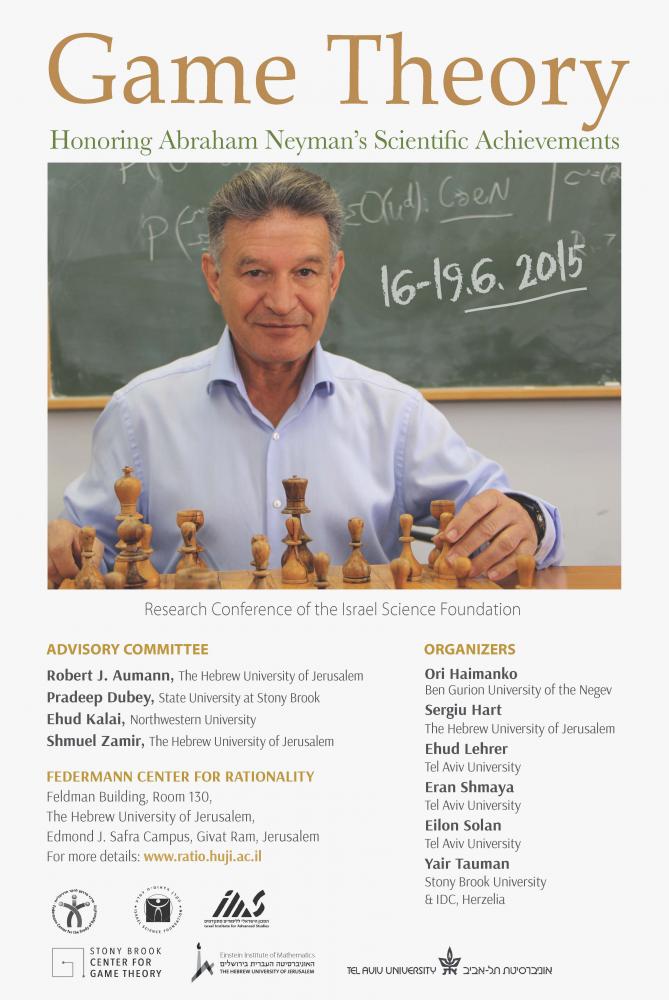 Here is Neyman's talk from the conference:
Yom Holedet Sameach, Abraham! I'm sorry to have to miss the party.
Yom Holedet Sameach, Abraham! I'm sorry to have to miss the party.
Sunday, May 31, 2015
Kellogg celebrates Ehud Kalai

Life Is Full of Big Games
By Kellogg Insight | Based on the insights of Ehud Kalai
"From optimizing our daily commute to choosing whether or not to purchase Apple’s latest gadget, our lives are filled with instances of strategic decision making. And while most of us are vaguely aware of the larger systems at work (the city’s transportation network; the marketplace for technology products), our main concern is to navigate the chaos of modern life.
Ehud Kalai, a professor of managerial economics and decision sciences at the Kellogg School who recently delivered the prestigious 2015 Nancy L. Schwartz Memorial Lecture, has spent his career as a game theorist trying to model this type of chaos. He views commuters and smart-watch buyers as participants in “big games”—scenarios that involve the repeated interaction of many “players,” other examples of which include financial markets, healthcare management, and the education system. Kalai is especially interested in what game theorists call “rational learning”—in other words, how people learn to play. “Rational learning,” he says, “can ultimately lead to more stability.”
Saturday, May 30, 2015
Sylvia Nasar on John Nash in the Wash Po, and John Cassidy on Nash equilibrium in the New Yorker
The Washington Post has an interview with Sylvia Nasar: The author of ‘A Beautiful Mind’ on the life and death of John Nash
Here's one question and answer:
"ZG: How did he spend the last 21 years, since he won the Nobel?
SN: The first time I saw him was a few months after he won the Nobel, and he was going to a game theory conference in Israel. He was surrounded by other mathematicians, and he looked like someone who had been mentally ill. His clothes were mismatched. His front teeth were rotted down to the gums. He didn’t make eye contact. But, over time, he got his teeth fixed. He started wearing nice clothes that Alicia could afford to buy him. He got used to being around people.
He and Alicia spent a lot of their time taking care of their son, Johnny, and doing the things that are so ordinary that the rest of us don’t think about them. Once I asked him what difference the Nobel Prize money made, and he literally said, “Well, now I can go into Starbucks and buy a $2 cup of coffee. I couldn’t do that when I was poor.” He got a driver's license. He had lunch most days with other mathematicians, reintegrating into the one community that mattered to him most.
The last time I was with him was about a year ago when Alicia organized a really lovely dinner with us and two other couples. John was talking about all the invitations they’ve gotten and all the places they’ve planned to travel. Johnny was there. He was still very sick. They took him to a lot of the places they went and always tried to include him. Their life was a mix of glamour and celebrity – and the day-to-day which revolved around Johnny, who by then was in his 50s and was as sick as his father ever was and entirely dependent on them."
**************
The New Yorker has an article by John Cassidy, on Nash equilibrium:
The Triumph (and Failure) of John Nash’s Game Theory
I was surprised to see the following, but I think it might be right--Nash's influence is ubiquitous, even when we're showing how hard it can be to reach Nash equilibrium:
"Indeed, in a 2004 article for the National Academy of Sciences that reviewed the genesis and development of Nash-based game theory, the economists Charles Holt and Alvin Roth noted, “Students in economics classes today probably hear John Nash’s name as much as or more than that of any economist.”"
Here's one question and answer:
"ZG: How did he spend the last 21 years, since he won the Nobel?
SN: The first time I saw him was a few months after he won the Nobel, and he was going to a game theory conference in Israel. He was surrounded by other mathematicians, and he looked like someone who had been mentally ill. His clothes were mismatched. His front teeth were rotted down to the gums. He didn’t make eye contact. But, over time, he got his teeth fixed. He started wearing nice clothes that Alicia could afford to buy him. He got used to being around people.
He and Alicia spent a lot of their time taking care of their son, Johnny, and doing the things that are so ordinary that the rest of us don’t think about them. Once I asked him what difference the Nobel Prize money made, and he literally said, “Well, now I can go into Starbucks and buy a $2 cup of coffee. I couldn’t do that when I was poor.” He got a driver's license. He had lunch most days with other mathematicians, reintegrating into the one community that mattered to him most.
The last time I was with him was about a year ago when Alicia organized a really lovely dinner with us and two other couples. John was talking about all the invitations they’ve gotten and all the places they’ve planned to travel. Johnny was there. He was still very sick. They took him to a lot of the places they went and always tried to include him. Their life was a mix of glamour and celebrity – and the day-to-day which revolved around Johnny, who by then was in his 50s and was as sick as his father ever was and entirely dependent on them."
**************
The New Yorker has an article by John Cassidy, on Nash equilibrium:
The Triumph (and Failure) of John Nash’s Game Theory
I was surprised to see the following, but I think it might be right--Nash's influence is ubiquitous, even when we're showing how hard it can be to reach Nash equilibrium:
"Indeed, in a 2004 article for the National Academy of Sciences that reviewed the genesis and development of Nash-based game theory, the economists Charles Holt and Alvin Roth noted, “Students in economics classes today probably hear John Nash’s name as much as or more than that of any economist.”"
Tuesday, May 26, 2015
Bob Aumann remembers John Nash
From Ynet..
.
John Nash, a teacher and a mentor
I met him in 1953, when he was a young lecturer who had just started teaching at the university and I was coming to the end of my doctorate. He was the one who first introduced me to game theory. He is my first mentor and teacher on the subject.

John Nash. A giant in his field. (Photo: Peter Badge / Typos 1)
The truth is that I didn't give the field much thought at the time because I was busy with pure mathematics. Later, however, when I moved to a performance studies consulting firm, I encountered a difficult problem and then I realized the importance of game theory – and I recalled my conversations with Nash.
John Nash is definitely one of the giants of game theory, which is an important tool in economics and numerous other areas. He invented it, the key concept known as "equilibrium strategy;" and not only did he found the field, but he was also a game-theory giant. And he was also one of the first to receive a Nobel Prize for game theory. It was in 1994, and he shared it with two others. I am shocked to hear of his death.
In recent years, we met at least once a year at international conferences. He knew a lot – not only about mathematics but about everything, and you could talk to him about what is happening in the world.
Nash came to Israel in 1995, on my 65th birthday, which took place at the Tower of David in the form of a celebration and conference. It was a year after he received the Nobel Prize in Economics. The science world and I will certainly miss him."
.
John Nash, a teacher and a mentor
Nash was definitely one of the giants of game theory, writes Israeli Nobel laureate Yisrael Aumann, and the science world will miss him.
Prof. Yisrael Aumann
|
I met him in 1953, when he was a young lecturer who had just started teaching at the university and I was coming to the end of my doctorate. He was the one who first introduced me to game theory. He is my first mentor and teacher on the subject.
John Nash. A giant in his field. (Photo: Peter Badge / Typos 1)
The truth is that I didn't give the field much thought at the time because I was busy with pure mathematics. Later, however, when I moved to a performance studies consulting firm, I encountered a difficult problem and then I realized the importance of game theory – and I recalled my conversations with Nash.
John Nash is definitely one of the giants of game theory, which is an important tool in economics and numerous other areas. He invented it, the key concept known as "equilibrium strategy;" and not only did he found the field, but he was also a game-theory giant. And he was also one of the first to receive a Nobel Prize for game theory. It was in 1994, and he shared it with two others. I am shocked to hear of his death.
In recent years, we met at least once a year at international conferences. He knew a lot – not only about mathematics but about everything, and you could talk to him about what is happening in the world.
Nash came to Israel in 1995, on my 65th birthday, which took place at the Tower of David in the form of a celebration and conference. It was a year after he received the Nobel Prize in Economics. The science world and I will certainly miss him."
Sunday, May 24, 2015
John Nash: 1928-2015. RIP
John and Alicia Nash have died in a car accident.
Here's the news story: Famed Princeton mathematician John Nash, wife killed in taxi crash
Here's the NY Times obituary: John F. Nash Jr., Mathematician Whose Life Story Inspired ‘A Beautiful Mind,’ Dies at 86
Here's the news story: Famed Princeton mathematician John Nash, wife killed in taxi crash
Here's the NY Times obituary: John F. Nash Jr., Mathematician Whose Life Story Inspired ‘A Beautiful Mind,’ Dies at 86
Thursday, May 21, 2015
Royal Economic Society-York Symposium and Mini-Courses on Game Theory, 21-23 May 2015
The 2015 RES-York Symposium and Mini-Courses on Game Theory, the 6th of the series of York Annual Symposium on Game Theory, will be held on 21-23 May 2015 at the Department of Economics and Related Studies, University of York, UK.
The four keynote speakers of the Symposium (21-22 May 2015) are:
Bhaskar Dutta (Warwick)
Stephen Morris (Princeton)
Michael Ostrovsky (Stanford)
Eyal Winter (HUJerusalem & Leicester)
The event is organised by the Micro Theory Research Cluster at the Department of Economics and Related Studies (DERS), University of York, and is jointly supported by the Royal Economic Society and the departmental Research Impact Support (RIS) Fund at DERS, University of York.
Mini-Courses
Right after the Symposium, on Saturday 23 May 2015, we will run two mini-courses delivered by Professor Bhaskar Dutta (Warwick) and Professor Michael Ostrovsky (Stanford), respectively.
Professor Bhaskar Dutta will deliver a mini-course on "Games on Networks".
Professor Michael Ostrovsky will deliver a mini-course on the topic "Matching in Trading Networks". The background reading can be downloaded below at this webpage.
The schedule on Saturday 23 May 2015 is as follows.
9:00-10:30 Course by Prof. Bhaskar Dutta
10:45-12:15 Course by Prof. Michael Ostrovsky
12:15-13:15 Lunch
13:15-14:45 Course by Prof. Bhaskar Dutta
15:00-16:30 Course by Prof. Michael Ostrovsky
Monday, April 20, 2015
Dynamic Games: 26th Jerusalem Summer School in Economic Theory (deadline April 27)
26th Jerusalem School in Economic Theory
Dynamic Games
Organizers:
- Eric Maskin, Director (Harvard University)
Elchanan Ben-Porath, Codirector (The Hebrew University)
Drew Fudenberg (Harvard University)
In many economic, social, and political settings, participants interact strategically not just once but over time.
When raising its import tariffs today, for example, a country will try to anticipate the reactions of its trading partners tomorrow. And an oligopolistic firm can learn from its rivals’ past pricing behavior so as to gauge what prices they are likely to set now.
The Summer School will emphasize theoretical aspects of dynamic games, but will also include work on experiments.
List of speakers:
Robert Aumann (The Hebrew University)
Martin Cripps (University College London)
Guillaume Fréchette (New York University)
Drew Fudenberg (Harvard University)
Sergiu Hart (The Hebrew University)
Johannes Hörner (Yale University)
Navin Kartik (Columbia University)
George Mailath (University of Pennsylvania)
Eric Maskin (Harvard University)
Abraham Neyman (The Hebrew University)
Larry Samuelson (Yale University)
Alistair Wilson (University of Pittsburgh)
Subscribe to:
Posts (Atom)